To check an expired domain for spam, review the anchor-text distribution, referring domains, linked pages, archive timeline, former topics, redirects, ranking keywords, and evidence coverage together. Reject domains whose apparent authority comes from repeated commercial anchors, automated sitewide links, unrelated topic changes, or historical pages created mainly to manipulate search rankings.
No single score proves that a domain is clean. A low spam score can miss a bad period that was never crawled, while an unusual anchor can be harmless when it comes from a legitimate citation. The goal is not to find a magic threshold. It is to build a consistent body of evidence before you bid.
CatchSEO's clean expired-domain finder can narrow the first pass. The classification is a screening result based on the evidence available for that domain—not a guarantee, certification, or substitute for reviewing the underlying data.
A practical spam-check workflow
Use this order so that a strong headline metric does not bias the rest of the review:
- Confirm the domain and intended use. Write down what you plan to build and which former topics would be relevant.
- Review evidence coverage. Identify which backlink, traffic, archive, and classification fields are present and which are missing.
- Audit anchor text. Look for repeated commercial phrases, unrelated languages, adult, gambling, pharmaceutical, counterfeit, or hacked-site terms.
- Inspect referring domains. Verify the strongest sources, link placement, topical relevance, and whether apparent diversity comes from real independent sites.
- Trace linked URLs. Determine which old pages earned links and whether legitimate equivalent content could exist after acquisition.
- Read the archive as a timeline. Look for topic changes, doorway pages, mass-generated content, parking, redirects, and ownership transitions.
- Compare traffic and keywords with the history. Investigate sudden gains, collapses, and queries unrelated to the archived site.
- Check brands and trademarks. Spam-free does not mean legally or reputationally safe.
- Record a decision and reasons. Mark the domain pass, investigate, or reject; do not leave unresolved evidence hidden behind an average score.
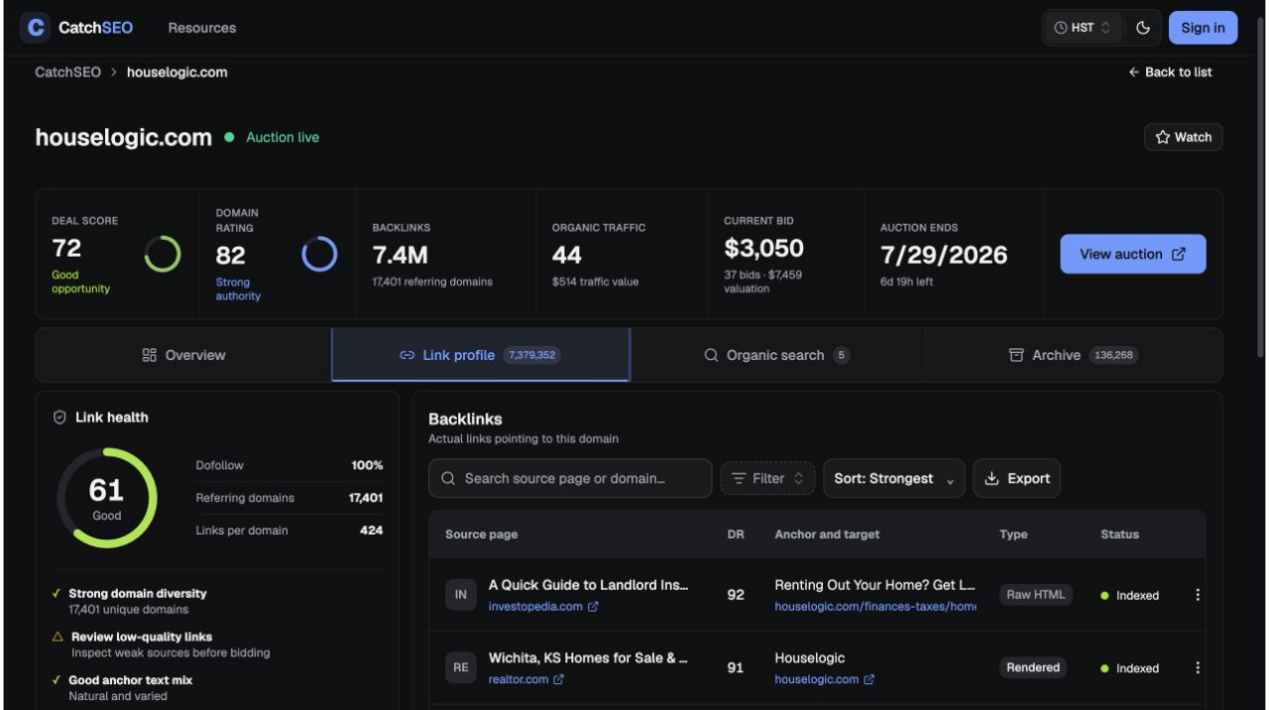
Start from live domain auctions or the central expired-domain resources and finder, then open an individual domain report for the checks below.
1. Treat missing evidence as unresolved
Before interpreting any metric, ask whether the relevant data was collected successfully. A domain with no anchor sample, no usable archive captures, or incomplete backlink enrichment has not passed those checks. It simply has unanswered questions.
This distinction matters because missing data can look deceptively quiet. A blank spam label is not the same as a clean result. A zero traffic estimate is not proof that the domain never received traffic. An empty archive period may mean the site was not captured, blocked crawlers, redirected elsewhere, or was inactive.
On CatchSEO, use the filter and metric definitions to understand null values, estimates, and classification fields. If evidence central to your intended use is unavailable, wait for enrichment, verify it independently, or remove the domain from the shortlist.
2. Audit the anchor-text distribution
Anchor text is the visible or descriptive text used in a link. A natural profile commonly contains a mixture of the former brand, the plain domain or URL, page titles, names, citations, and varied descriptive phrases. Exact proportions differ by site, so do not enforce a universal brand-versus-keyword ratio.
Investigate these patterns:
- One commercial phrase repeated across many unrelated sites.
- Large groups of anchors in a language that does not match the former website.
- Gambling, adult, pharmaceutical, payday-loan, counterfeit, or essay-spam terms unrelated to the legitimate history.
- Anchors that look injected into templates, comments, author biographies, or compromised pages.
- Thousands of near-identical anchors produced by sitewide navigation or widgets.
- A sudden shift from branded citations to exact-match keywords during one historical period.
Context changes the interpretation. A pharmacy domain may legitimately attract pharmaceutical anchors; the same anchors on a former school website are alarming. Open the linking page and compare its date and subject with archived versions of the target domain.
Google identifies links created primarily to manipulate rankings as link spam. That policy is useful as a definition of the risk, but only Google can determine how its systems interpret a particular link or domain.
3. Verify referring domains, not just backlink totals
A backlink count can be dominated by one website linking from every page. Referring-domain counts reduce that distortion, but they can still be inflated by networks of low-quality sites or many subdomains controlled by one operator.
For the strongest referring domains, ask:
- Is the linking website a real publication, organization, business, institution, or community?
- Is the page topically related to the old target page?
- Does the link sit inside relevant editorial content, or in a repeated template, directory, comment, or footer?
- Is the linking page live and indexable now?
- Does the source appear to be part of a coordinated network with duplicated design and content?
- Does the source link to many unrelated expired domains with commercial anchors?
Review expired domains with backlinks by referring-domain evidence, then inspect the actual sources. Ten durable, relevant editorial references can be more meaningful than hundreds of thousands of automated links. The complete backlink-checking guide expands this into a source, anchor, destination-page, concentration, timeline, and retained-value workflow.
Also expect link loss. Publishers may remove or update links when an old page disappears or a domain changes ownership. Spam screening answers whether the profile appears manipulated; it does not guarantee that legitimate links will remain.
4. Find which old URLs earned the links
Do not stop at the homepage-level authority score. List the historical URLs receiving the strongest links. The value may be concentrated in research, tools, reports, product pages, or news stories that no longer exist.
For each important URL, compare:
- The old page's subject and purpose.
- The source pages linking to it.
- Whether an archive capture shows the content that earned the citation.
- Whether your planned site can provide a genuinely equivalent resource.
- Whether the URL later redirected to an unrelated commercial page.
A pattern of strong links to useful old resources can support a legitimate restoration plan. A pattern of links funneled through thin pages, irrelevant redirects, or mass-generated location pages is a reason to reject or investigate further.
Avoid replacing every historical URL with a homepage redirect. That discards context for users and does not recreate the cited resource. Preserve a path only when you can publish content that honestly satisfies the reason people linked to it.
5. Review the archive as a history, not a screenshot
One attractive capture cannot represent a domain's full life. Review multiple years and sample periods around major changes in links or traffic.
Build a simple timeline with:
- First and last usable captures.
- Long gaps in archive coverage.
- Former organizations, brands, owners, and languages.
- Changes in topic, design, and site structure.
- Periods of parking, blank responses, or sale pages.
- Redirect destinations.
- Doorway pages, scraped articles, spun text, or large groups of near-duplicate pages.
- Hacked content or injected commercial sections.
A topic change is not automatically spam. Businesses pivot, organizations merge, and domains are legitimately resold. The concern is a history whose content and links appear designed mainly to exploit prior authority or deceive users.
Google's spam policies define expired domain abuse as repurposing an expired domain primarily to manipulate rankings with content that provides little or no value. Buying an expired domain is not itself the violation; the purpose and resulting content matter.
Archive gaps require restraint. A missing year is unknown, not evidence that nothing happened. CatchSEO reports available archive captures and continuity signals, but archive coverage differs by domain and date.
6. Check redirects and ownership transitions
Historical redirects can reveal uses that a homepage screenshot misses. Investigate whether the domain redirected to:
- An obvious successor organization or documented rebrand.
- A closely related property under the same owner.
- An unrelated affiliate, casino, adult, pharmaceutical, or lead-generation site.
- Several different destinations over a short period.
- A path that attempted to inherit traffic from a former brand.
A legitimate merger redirect and an unrelated authority-harvesting redirect can look identical at the HTTP level. Use archived pages, search results, company records, and the destination's topic to interpret it.
Repeated ownership and topic changes increase uncertainty even when none is individually conclusive. Record each transition so you can distinguish the coherent history from later experiments.
7. Compare organic traffic, keywords, and pages
Use expired domains with estimated organic traffic as a discovery source, then inspect what creates the estimate.
Look for inconsistencies:
- Traffic peaks after the legitimate site disappeared.
- Ranking terms belong to an unrelated country, language, or industry.
- Most estimated traffic comes from a few pages that no longer exist.
- Keywords are dominated by copied media, piracy, adult, gambling, pharmaceutical, or coupon queries unrelated to the former organization.
- Traffic collapses at the same time as a topic change or redirect.
Third-party traffic numbers are estimates, not first-party analytics. A decline can reflect removed content, ordinary ranking changes, seasonality, measurement gaps, lost links, or spam remediation. Use the timeline to form a hypothesis, then seek corroborating evidence instead of assigning a cause from the chart alone.
8. Separate spam risk from brand and legal risk
A backlink profile can look natural while the name remains unsafe to use. Search for the former organization, current businesses using the name, active social accounts, news coverage, and relevant trademark records. The USPTO trademark search is one starting point for United States marks; other jurisdictions have their own databases.
Distinctive former brands deserve extra care. Do not imply affiliation, impersonate the former owner, collect messages intended for them, or reuse protected creative work. Consult a qualified lawyer when the name or intended use creates material legal uncertainty.
This check also protects users. A domain formerly used by a bank, clinic, government service, school, or well-known company may continue receiving sensitive visits or email even if its link profile is technically clean.
9. Use a pass, investigate, reject decision
A written decision prevents one impressive metric from overruling unresolved risk.
Pass to valuation
Use this only when the available evidence is coherent: natural anchors, credible referring domains, relevant linked pages, a stable or explainable archive history, compatible keywords, and no unresolved brand conflict. Passing spam review does not mean the domain is worth its price; next compare it with completed domain-auction statistics.
Investigate further
Choose this when the domain may be useful but essential evidence is incomplete or ambiguous—for example, a large archive gap, a sharp traffic change, a cluster of unusual anchors, or an ownership transition you cannot explain.
Reject
Reject when the strongest evidence depends on manipulative links, unrelated authority reuse, hacked or mass-generated content, deceptive redirects, an active brand conflict, or a history incompatible with the intended project. The opportunity cost of more investigation should be part of the decision.
Expired-domain spam checklist
Before bidding, confirm that you have:
- Defined a legitimate use that fits the domain's strongest historical topic.
- Distinguished unavailable evidence from a clean result.
- Reviewed the full anchor distribution and opened suspicious sources.
- Checked referring-domain quality and ownership patterns.
- Identified the URLs that earned important links.
- Sampled archive captures across multiple years and around topic changes.
- Investigated redirects, parked periods, and ownership transitions.
- Compared traffic estimates with ranking keywords and pages.
- Searched for active brands and relevant trademarks.
- Recorded a pass, investigate, or reject decision with reasons.
- Set a bid ceiling only after the spam review is complete.
For the broader acquisition process, continue with How to Find Expired Domains Worth Buying. For definitions and evidence limitations, read How CatchSEO collects and reviews domain data.
Frequently asked questions
What is a spammy expired domain?
A spammy expired domain has evidence of manipulative or abusive historical use, such as coordinated link schemes, unrelated exact-match anchors, doorway or mass-generated pages, hacked content, deceptive redirects, or repurposing primarily intended to exploit prior authority. A strange link alone is not enough; assess the pattern and context.
Is Domain Rating enough to check domain quality?
No. Domain Rating summarizes one provider's view of backlink strength. It does not establish topical relevance, link legitimacy, archive continuity, trademark safety, traffic quality, or future rankings. Use it to prioritize investigation, not to replace it.
Does a clean spam-risk label guarantee that a domain is safe?
No. It means the evidence examined met the classifier's stated screening criteria. Evidence can be incomplete, links can change, archive coverage can have gaps, and legal or reputational concerns sit outside a backlink-spam label. Review the source evidence yourself.
Can I rebuild the old website after buying the domain?
You may create new content that legitimately serves the topic, but ownership of the domain does not give you ownership of the former site's copyrighted text, images, trademarks, user data, or identity. Recreate useful resources in your own work and obtain legal advice when rights are unclear.
How this guide was researched
CatchSEO Research prepared this guide from the fields available in CatchSEO domain reports, recurring patterns in backlink and archive review, and the primary-source policies linked above. AI assisted with drafting and editing; a human reviewed the structure, claims, links, and evidence limits before publication. See the full research, publishing, and corrections methodology.